A Tale of of RNA Manufacturing
November 03, 2025
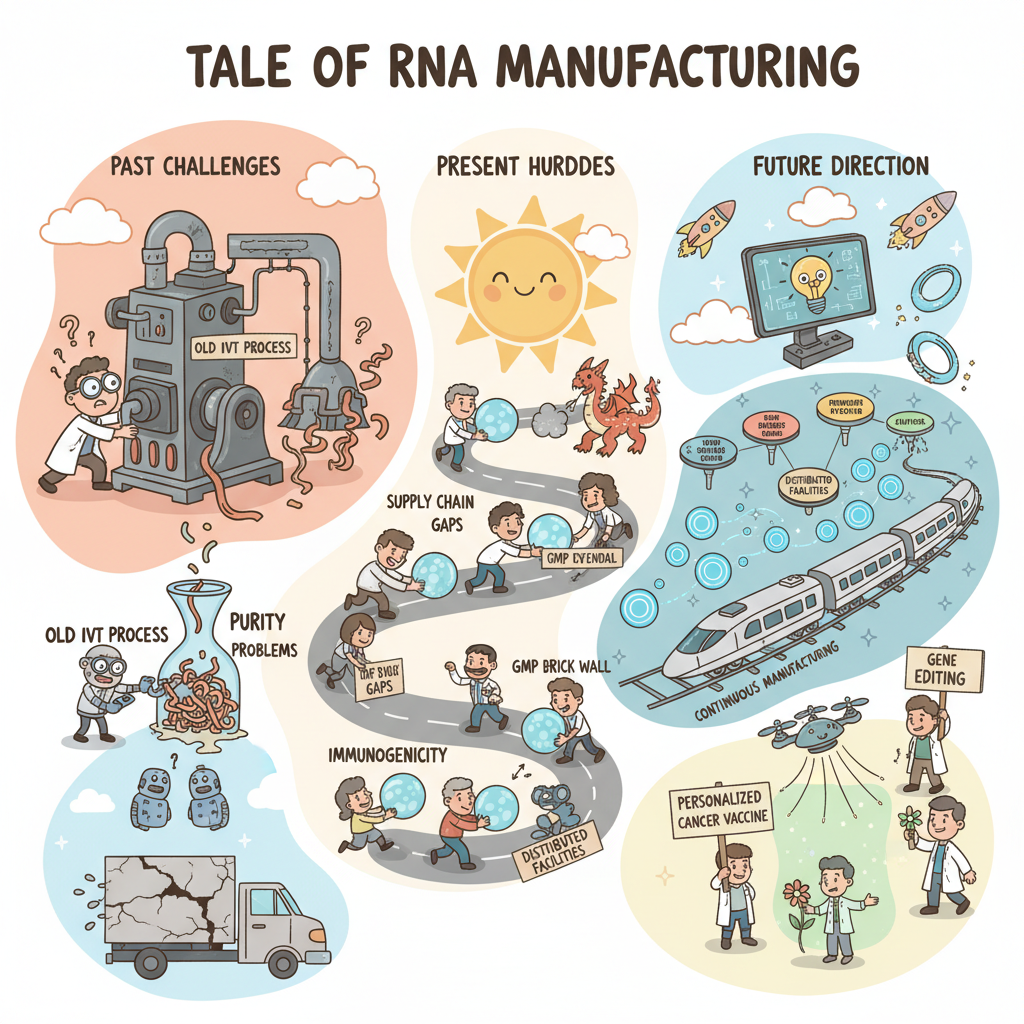
The dramatic success of mRNA vaccines during the COVID-19 pandemic propelled RNA manufacturing into the spotlight, transforming it from a niche scientific pursuit into a cornerstone of modern medicine. As the field expands beyond emergency response to a diverse range of therapeutic applications, it is tackling significant challenges in scalability, purity, and stability. While the journey from lab to widespread clinical use is still in its early stages, the rapid pace of innovation promises to unlock the full potential of this powerful technology.
Current Challenges in RNA Manufacturing
-
Scalability and Production Efficiency: A major hurdle is the need to efficiently scale up production while maintaining high quality. The in vitro transcription (IVT) process, which is the cornerstone of mRNA synthesis, faces limitations in yield and often generates unwanted byproducts. While the pandemic spurred the creation of large-scale infrastructure, the future will require adaptable, smaller-scale production for personalized medicines and rare diseases, posing a different set of challenges.
-
Purity and Quality Control: Ensuring the purity of RNA products is critical. Impurities can trigger adverse immune responses even at very low concentrations. Traditional purification methods often struggle to balance high yield with the ultra-high purity required for clinical applications.
-
Stability and Delivery: RNA molecules are inherently unstable and prone to degradation by nucleases. They also struggle to cross cell membranes to reach their target. Lipid nanoparticles (LNPs) have been a revolutionary solution, but ongoing research is needed to improve delivery efficiency and stability for a wider range of applications and target tissues.
-
Supply Chain and Logistics: The manufacturing process is complex, involving multiple specialized steps, from DNA template production to final formulation. This can lead to an uncoordinated “relay race” if multiple vendors are involved, causing delays and inefficiencies. The reliance on Good Manufacturing Practice (GMP)-grade raw materials, which are often in limited supply, can also create bottlenecks.
-
Immunogenicity: While modifications to RNA bases have been crucial in reducing the immune response to therapeutic RNA, unwanted byproducts and certain formulations can still activate the immune system, which can be a problem for long-term treatments.
Future Direction of RNA Manufacturing
Continuous and Distributed Manufacturing: The industry is moving toward more streamlined and efficient processes. Continuous manufacturing, which involves an integrated, end-to-end production system, is a key trend that aims to enhance process reliability and minimize contamination. There is also a push for smaller, distributed manufacturing facilities that can support the rapid, on-demand production of personalized therapies.
Innovations in Synthesis and Purification: Advanced Enzymes and Templates: The development of engineered enzymes and optimized DNA templates is improving the efficiency and yield of IVT while reducing byproduct formation.
Novel Purification Techniques: New technologies like affinity resins, monolithic columns, and nanofiltration are being developed to improve the removal of impurities and increase the purity of the final product.
Next-Generation RNA Molecules: The field is expanding beyond standard linear mRNA to include new modalities with enhanced properties: Self-Amplifying RNA (saRNA): These molecules can amplify themselves once inside a cell, allowing for lower doses and potentially longer-lasting effects. Circular RNA (circRNA): These closed-loop molecules are more stable and resistant to degradation than linear mRNA, offering potential for long-term protein expression.
Artificial Intelligence and Automation: AI and machine learning are being used to design more effective and stable RNA sequences with fewer side effects. This computational approach can accelerate drug development and optimize the design of RNA drugs.
Broadening Therapeutic Applications: The future of RNA manufacturing extends far beyond vaccines for infectious diseases. The technology is being explored for a wide range of applications, including: Personalized Cancer Vaccines: Tailored treatments that use a patient’s own tumor antigens to stimulate an immune response. Gene Editing: Using RNA as a guide molecule for CRISPR and other gene-editing tools. Protein Replacement Therapy: Providing the instructions for a cell to produce a missing or defective protein. Treatment of Rare Diseases and Autoimmune Disorders: Offering new possibilities for conditions with limited treatment options.
Summary
The evolution of RNA manufacturing represents a critical pivot point in medicine, moving toward a future where rapid, on-demand, and personalized therapies are a reality. By addressing the current challenges in production, quality control, and delivery, the industry is paving the way for a new generation of RNA-based treatments that can tackle everything from chronic diseases to complex genetic disorders. The continued innovation in this space promises to unlock unprecedented possibilities, solidifying RNA’s role as a cornerstone of the next medical revolution.
Disclaimer:
The information provided in this article is for general informational and educational purposes only. It is not intended as, and should not be construed as, professional business, legal, investment, or medical advice. Before making any strategic decisions, you should consult with a qualified professional. Calxera makes no representation or warranty of any kind, express or implied, regarding the accuracy, adequacy, validity, reliability, availability, or completeness of any information on this site.