A brief Introduction of Antibody-Bottlebrush Prodrug Conjugates (ABCs)
October 13, 2025
A recent publication by a group of talented chemists at MIT unveils a next-generation platform called Antibody-Bottlebrush prodrug Conjugates (ABCs) for targeted cancer therapy, designed to overcome limitations of traditional Antibody-Drug Conjugates (ADCs).
https://www.nature.com/articles/s41587-025-02772-z
What is an ABC?
The development of ABC technology originated from research led by the Jeremiah Johnson lab. ABC is a new technology to guide specific cancer therapies to the right location. An ABC utilizes an IgG1 monoclonal antibody covalently conjugated to the terminus of a compact bivalent bottlebrush prodrug that has payloads bound through cleavable linkers and polyethylene glycol branches. This design enables the synthesis of ABCs with tunable average drug-to-antibody ratios up to two orders of magnitude greater than those of traditional ADCs.
Advantages of ABCs
ABCs offer several significant advantages over traditional ADCs: Significantly Higher Drug-to-Antibody Ratio (DAR): Traditional ADCs are typically limited to a DAR of 2 to 8. ABCs can achieve tunable average DARs up to two orders of magnitude greater without negatively impacting the antibody’s physical properties.
Broader Payload Scope: The flexible payload capacity of ABCs breaks the limit for using only highly potent, toxic drugs (like those used in ADCs). This opens the door to using less potent drugs, drug combinations, or other therapeutic agents like protein degraders or imaging agents.
Improved Efficacy and Safety: Preclinical studies have shown that ABCs can achieve superior efficacy and tumor regression in models compared to conventional ADCs, often at much lower doses of the small-molecule drug, which suggests the potential for reduced off-target toxicity.
Tunable Drug Release: The cleavable linkers attached to the bottlebrush can be chemically tailored to control the drug release rate and ensure activation preferentially in the tumor environment.
Manufacturing Efficiency: The modular synthesis using ‘click’ chemistry allows for the efficient creation of various ABCs for different targets and payloads.
Future directions of ABCs
ABCs represent a potential next-generation leap that directly addresses the fundamental limitation of low DAR in ADCs. It would be nice to see further applications of this technology to demonstrate clinical translation.
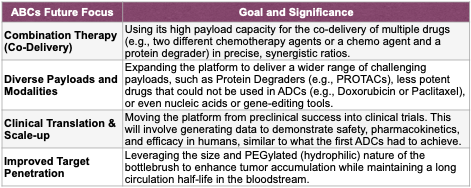
In essence, ABCs are poised to become a platform technology that can house the future innovations of payloads and linkers while simultaneously solving the core problem of drug loading capacity. ADC and ABC technologies are not strictly rivals but represent a progression: ADCs are refining the present, while ABCs are laying the groundwork for a more versatile, high-capacity future of targeted therapeutics. Can’t wait to hear more exciting news on ABC’s clinical translation and applications beyond oncology therapeutic area.
Disclaimer:
The information provided in this article is for general informational and educational purposes only. It is not intended as, and should not be construed as, professional business, legal, investment, or medical advice. Before making any strategic decisions, you should consult with a qualified professional. Calxera makes no representation or warranty of any kind, express or implied, regarding the accuracy, adequacy, validity, reliability, availability, or completeness of any information on this site.