Beyond Cash Runway: How Much Trial-and-Error Capacity Does Your company Have?
November 18, 2026
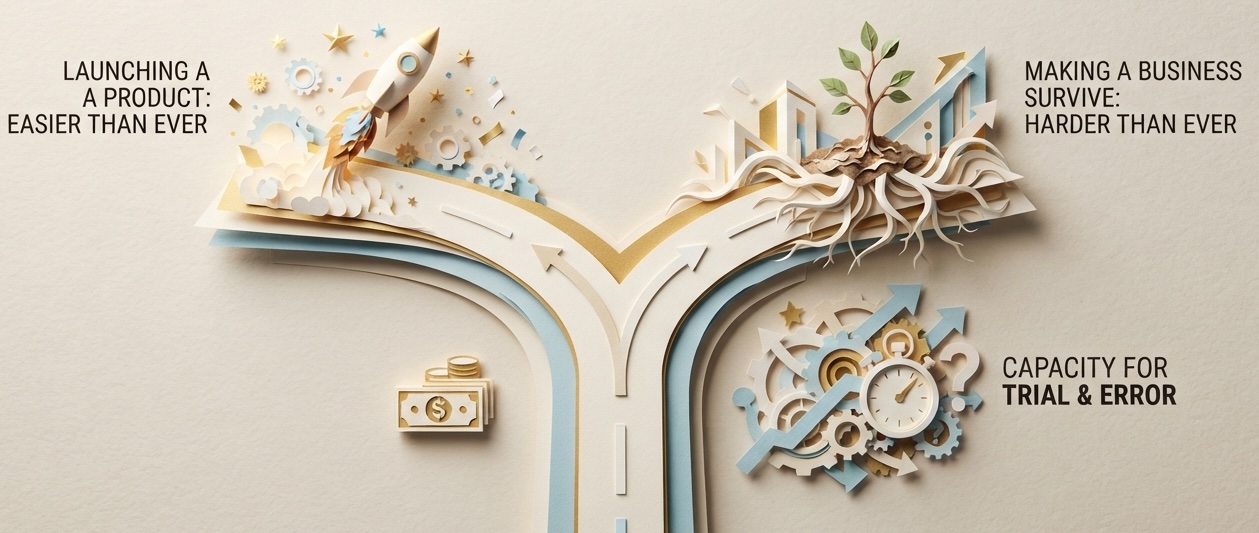
Launching a product has never been easier. Making a business survive has rarely been harder.
Every week, lean bootstrapped teams hit profitability at incredible speed—while well-funded startups quietly stall out. The difference isn’t necessarily the quality of their ideas or the size of their funding. It’s also how much capacity they have to experiment, absorb setbacks and adapt.
When you’re standing at a critical fork in the road, the real question isn’t how much money is in the bank—it’s how much capacity for trial and error your business can actually sustain.
While every company’s situation varies, these three questions help founders map their true trial-and-error capacity:
1. What is your capacity for trial and error actually made of?
Look far beyond cash. Your capacity is built from interdependent resources: personal stamina, engineering bandwidth, board patience, team morale, and your own appetite for risk. A constraint in any single area may constrain the whole venture, even if money remains in the bank.
2. How much trial and error can you afford to survive?
Don’t just calculate your cash burn. Consider your strategic recovery time. If a pivot falls flat, how long will it take to recover—and what relationships, market goodwill and strategic options will remain for the next move? True affordability isn’t just about what you lose when you miss. It’s about what choices you still have afterward.
3. Are your decisions compounding learning or consuming capacity?
The return on trial and error is rarely linear. Some experiments generate actionable insights that make the next iteration sharper and cheaper. Others consume time, capital, and internal belief without reducing uncertainty. Are your decisions making your next move more informed—or making it harder to adapt?
Summary
Trial-and-error capacity is more than a passive buffer against failure. It is your most critical strategic asset. The founders who break through aren’t the ones who never miss—they are the ones who deliberately protect their options and keep learning.
If you’re navigating a high-stakes venture or a critical strategic pivot, explore Ideation Alchemy on the Calxera website. It offers a structured space to examine the hidden assumptions behind your decisions and what deserves closer scrutiny before you commit.
Disclaimer:
The information provided in this article is for general informational and educational purposes only. It is not intended as, and should not be construed as, professional business, legal, investment, or medical advice. Before making any strategic decisions, you should consult with a qualified professional. Calxera makes no representation or warranty of any kind, express or implied, regarding the accuracy, adequacy, validity, reliability, availability, or completeness of any information on this site.