The hardest decision is not “Build vs. Buy”
August 04, 2026
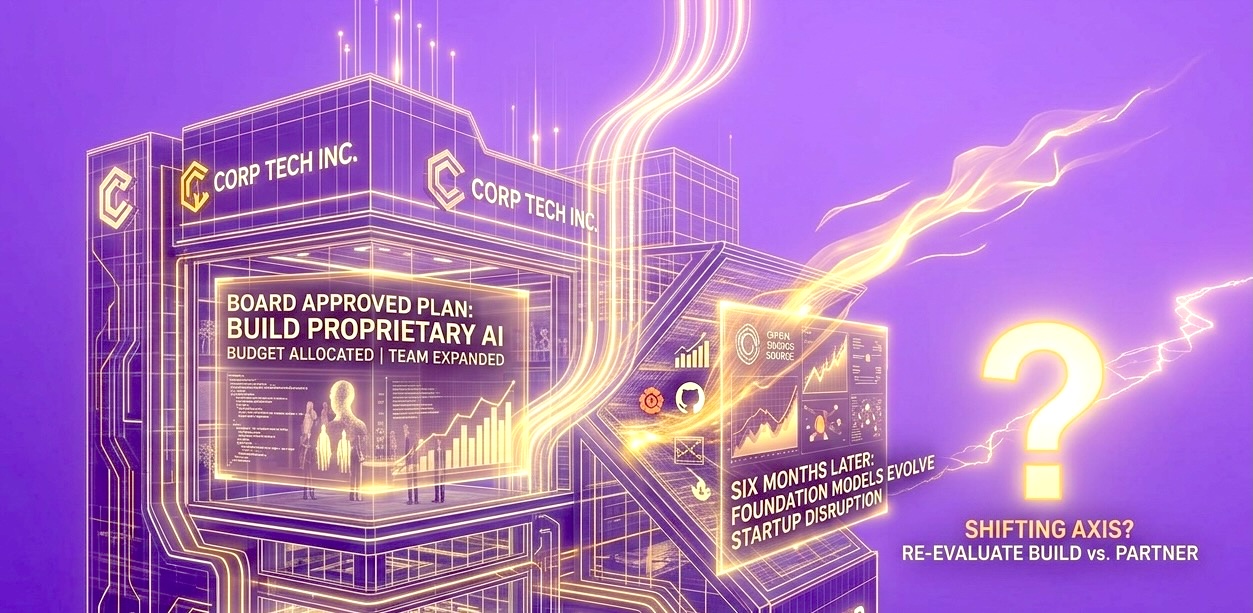
The board approves your proposal to build proprietary AI capabilities after rounds of persuasion. Budget is allocated. Hiring accelerated. Domain expertise expands… The decision is celebrated; The company believes it is investing in its future.
However, no one expects that six months later, foundation models evolve again; Specialized startups are suddenly in the spotlight; Capabilities that once required significant investment are becoming available across the ecosystem. Internal debates quickly intensify: Should we keep building? Should we partner instead? Has the axis shifted?
The tension doesn’t arise because the original decision was a misstep. It happens because a correct decision has suddenly been dropped into an entirely new context.
Beneath the discussions around AI, budgets, and execution, I often find a deeper question waiting to be surfaced:
What business are we actually trying to become?
A company building a long-term technology platform may answer that very differently from one preparing for acquisition.
The technology hasn’t changed. The destination has.
When pressure-testing decisions like these, I often ask three questions:
-
If nobody outside the company knew we built this internally, would we still make the same decision?
-
Are we solving a strategic problem—or responding to a market narrative?
-
If we succeed, what kind of company are we choosing to become?
That last question often changes the discussion. The debate is no longer whether to build or buy; It’s about identifying which capabilities genuinely deserve to become part of the company’s identity. Because capability decisions never end with capability. They quietly dictate future capital allocation, talent architecture, corporate culture, and long-term strategy. The issue isn’t uncertainty. It’s committing to an identity before deciding whether that’s the company you actually want to become.
Sometimes the pressure-test doesn’t change whether the company builds or buys, but it may change what the company decides is truly worth becoming. If you’re wrestling with a decision like this today, I’d be interested to hear how you’re framing it.
Disclaimer:
The information provided in this article is for general informational and educational purposes only. It is not intended as, and should not be construed as, professional business, legal, investment, or medical advice. Before making any strategic decisions, you should consult with a qualified professional. Calxera makes no representation or warranty of any kind, express or implied, regarding the accuracy, adequacy, validity, reliability, availability, or completeness of any information on this site.